My name is Anna McKie and I had Postnatal Depression (PND) after I birthed my surrogate baby.
Read on, for about (20 minutes), or listen to me read this reflection out (40 minutes)
.
.
.
.
Gosh even getting to the point of saying that out loud has been a long time coming as it’s a hard thing to come to terms with. I’m writing this 7 months after the birth of Baker, the surro bub I birthed for his two Dads, Matt and Brendan, who are also in Adelaide with me.
This is a long read. Come with me down the rabbit hole if you have time. It’s a chapter in a book, and a reflection piece for me.
Why am I even writing this?
This is a question I’ve been asking myself for a while. Is it presumptuous to assume anyone would want to read about it? Why would I want to go back to the bottom of the pit and relive my experiences, why not just move on?
I have decided to put my thoughts down for these reasons:
- To publicly thank those who helped me through the worst of it.
- To collate my thoughts so I can compartmentalise them and therefore move forward
- To bring an idea for different language to this topic
- To hope that it might help one future surrogate to speak up when she is struggling
- To take a leaf from Brené Brown and show my vulnerability. I have shame around this topic, but in trying to unpack that, I realise that the shame comes from a place where I fear it will disconnect me with people. But I need to flip that around, because to truly connect with people, I need to be authentic, vulnerable, and tell my story with my whole heart. So here goes.
Some background on me – I basically had PND after the birth of my own two children but I never officially got diagnosed. My own kids were 4 and 6 at the time of Baker’s birth. I put lots of strategies in place leading up to the birth of my son, as I didn’t want to go back to the place of struggling after the birth of my daughter. I breastfed both children for 12 months, and had a positive year of maternity leave the second time.
In the mandatory surrogacy counselling, we talked about my previous struggles…..but we didn’t create an action plan for how to ‘check in with Anna’ after Baker’s birth. Why? I put it down to me (or surrogates in general) being determined women, and we’re confident that we can handle whatever surrogacy throws at us. The counsellor we used for our mandatory counselling did a fine job, but due to my articulation about what strategies we had in place to combat potential PND, we never fully unpacked my previous struggles. Nor did the counsellor have a breadth of experience for being able to recognise and probe previous PND, whereas I shifted to Katrina Hale for ongoing counselling once pregnant and after birth, and she has much more experience with the full spectrum of surrogacy. We went for the cheaper and convenient option for mandatory counselling. I wish we had paid for Katrina for our mandatory counselling, but as a team we all decided not to.
Ultimately I would love to see the surrogacy counsellors in Australia have the opportunity to share their experiences with each other more often, so they can learn from each other and strengthen their craft. Suggestion for teams – ticking the box with a cheaper, convenient option with mandatory counselling with a less experienced counsellor is a risk. It might be ok, but surrogacy is all about relationships and connections, so if any team member is struggling (and we never know when these struggles will crop up) it will make things quicker and smoother later if you have a history with an experienced surrogacy counsellor.
The birth of Baker was amazing – have a read of my birth story or watch the photo slideshow. The week after birth was a once in a lifetime week for our team. We then started to ease into life after surrogacy and we had a plan in place for how to do that. We saw each other every day for a week, then moved to every second day, and continued to ease off as was comfortable for everyone.
So where did it all start to unravel?
Those first 3 months post birth are really a blur for me – as I know they are for the Dads too as they were adjusting to life with a newborn. On a side note, it’s worth teams discussing the possibility of PND for the IPs as well. These surro babies are very wanted children, they have been dreamt of for years, but they bring monotony, sleep deprivation and cries that are hard to decipher, so it’s inevitable that there will be times that IPs are challenged and quite frankly, hate. All team members need to make sure they have support and reach out for it. Easier said than done though. And this is where we all need people who are tasked to check in on us, and to ask both the surrogate and the now parents – are you ok?
I was expressing breastmilk (EBM) for Baker and did eventually make it to the 2 month mark for that. I had an app that kept track of this and I pumped 21 Litres over 191 pumps for the little man. EBM is a mammoth amount of work, and one that I’m proud of doing for Baker but also for my own physical recovery. For those new to the benefits of breastmilk, for the birth mother, expressing milk releases the happy hormone oxytocin. Looking back with my own 2 kids, breastfeeding for a year produced oxytocin many times a day, which probably helped to keep my PND at bay while my body created its own reserves again. However with Baker, as I weaned from expressing milk, the little hits of happy hormones reduced, and my big crash came at that 2 month post birth mark. Katrina Hale helped me to unpack this, and we then felt that my 4th trimester really started at that point, and therefore lasted 3 months, until I was 5 months post birth. I definitely felt like the fog lifted at 5 months post birth somewhat.
Suggestion for teams – if the surrogate is planning on expressing milk, take note of when she starts to reduce the number of times a day, or when she completely weans, as there will be a natural drop in oxytocin, which will mean her body needs to adjust to life without that happy hormone hit. Some women will cope better than others, but checking in with each other, and being on the front foot for all team members with this conversation will help.
But I’m treading water here with everything I’ve written so far, because diving down into how it really went is hard. Perhaps those reading have had their own struggles in life and can relate. Maybe you too have struggles with PND, or anxiety, or mental health challenges. Or maybe you’ve had fertility struggles, or cancer, or other life challenges where you spiralled down into a pit. This experience has taken me to my deepest pit, and I wish I could sit alongside that Anna, put my arm around her, let her cry and reassure her that she will climb out of the pit eventually.
At the 6 week post birth mark, I wrote the following message to a small group of surrogates and it was my first moment of reaching out for help. This is my first thanks to those with whom I felt safe. Amanda, Charmaine and Madeline – thank you for your friendship and kindness, your warmth and security, for listening and gently suggesting.
“I’m not ok.
But I also don’t have the emotional capacity or the time to explain it all in detail. Or the time to do a post and then reply to all of the comments…Could you direct me to some posts I could search for where other surrogates have said they are struggling and the elders have shared their support, so I could read those posts? In a nutshell I’m teary. Cry every day. Bloody hormones. I want more time in my day to do the things on my list but never enough time. I want to see the boys and people but I also don’t want to carve that time out. I feel a bit lonely in this journey. I’m not alone, but I feel lonely.
I miss Matt and Brendan and being so important to them. I’m taking lots of packets of breastmilk down tomorrow morning so that will be good to see them all I guess.”
The girls pointed me in the direction of posts that other surrogates had done when they were postnatal, and reading about the experience of others was helpful, as I realised that all of my feelings were normal. If you’re in the Australia Surrogates Support group, use the search function and type in “Amanda Meehan post birth” and find a post from 18 March 2018.
I had had one counselling with Katrina Hale at the 5 week post birth mark and that was a positive and helpful session at the end of October. In that week, we had 2 other debriefs – one with our midwife team as a final session with the Group Practice, and one with our HypnoBirthing educator Lauren. After these catch ups I remember this deep sense of peace that in the long term, the Dads were not going to abandon me. That they had been the steady same the whole way through our Surrodating, pregnancy and beyond, and they weren’t going anywhere. But assimilating this knowledge with a postnatal brain is another thing. I was wobbly but not all the time. I was muddled but then also going into a month of exam marking (I marked external Year 12 math exams in November). It was good to use my brain for the marking, as it helped to remind me of who I was and what my brain was capable of, but in hindsight, maybe it was too much. Adelaide also went into a short 6 day lockdown (thanks Woodville Pizza Shop 🍕) and this threw me into a spin too. My brain didn’t handle that uncertainty well at all.
At 7 weeks post birth, mid November, the Dads hosted an event called a Sip and See. Where people come to Sip champagne and See the baby. Baker had had his 6 week immunisations by this point, and it was a chance for Brendan’s interstate family to meet Baker.
I wrote about this in a message to another friend from the surrogacy community, Zoe Stefan, who is a mum through surrogacy.
“On the whole it was a good day but it was a hard day for me, very emotional with lots of tears. And as we say, feel the feels. Don’t fight them, so I didn’t. Looking back, that weekend almost felt like an out of body experience. Now I’m through it, I feel like those hormones took over my body and brain. Loading the esky of breastmilk was such a challenge. 40 packets of about 200mL each was a once in a lifetime delivery. I’ve started to wean now, so although there will be a bit more breast milk, it will never be an esky like that. As I put each packet into the esky, and I know this sounds dramatic but it was how my brain was thinking, it felt like I was lowering a coffin. I could barely see what I was doing from the tears, and my fingers were burning from the freezer cold of the packets. I asked husband Glen to take a photo because I wanted to remember the hard times of surrogacy.
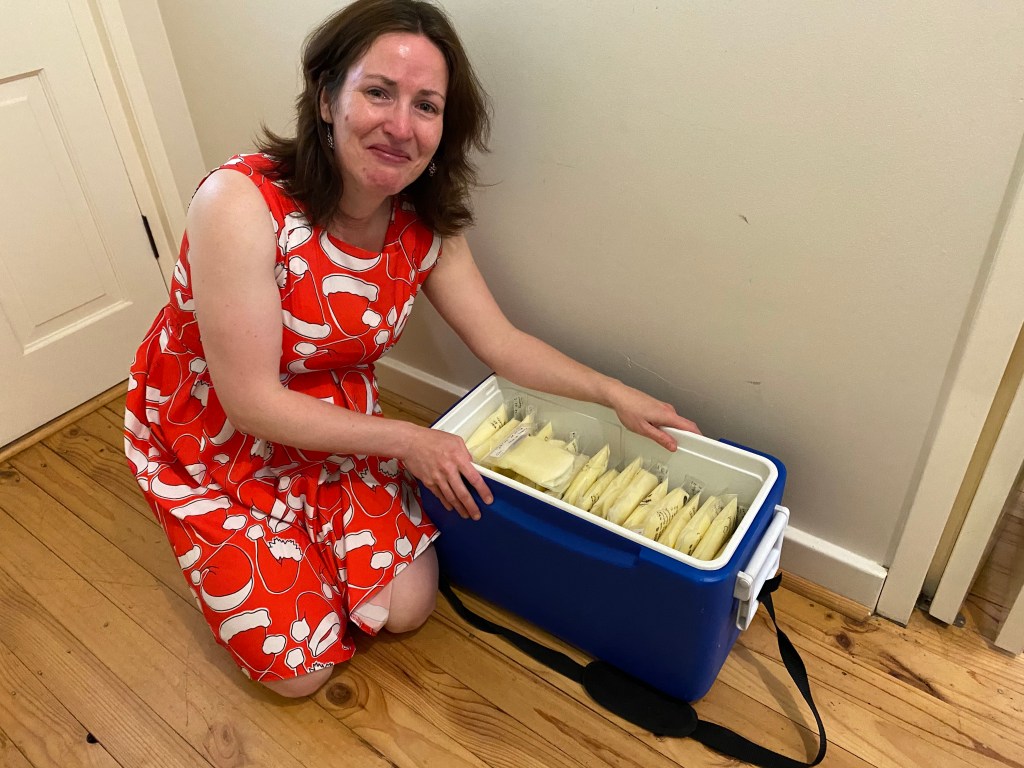
When we arrived, Glen and Matt loaded it into the freezer and I stood there and cried and cried, sobbing and probably wailing like a bereaved woman. I couldn’t help it. Brendan came up to me, put his arm around me and asked what’s wrong. I couldn’t answer. So he hugged me. I asked for a second hug after and I still couldn’t articulate what was wrong, because it wasn’t a quick answer. So I walked away after the hugging was done and the freezer full.
One of their gay mum friends, Katherine, helped to facilitate cuddles with Baker a bit later and I am deeply grateful to her for that. I gathered up my kids, Emily and Ewan, and Katherine suggested we go into the lounge where it was quiet. As I sat on the couch, ready for her to pass Baker to me, my heart broke/exploded. Crying now as I write this. She hugged me as I cried, and the cry was a deep, sobbing thing. My body collapsed into her shoulder as I let it all out. I think she understood and recognised that I needed that time. Baker then started to cry so I picked him up (Katherine had put him on the couch while she hugged me), and then my focus was on him. Glen was there too and he helped to navigate Emily and Ewan to either side of me to see Baker. I decided to sing to Baker. There’s a special song I’ve been singing to my kids, usually at bedtime, since they were born, and so Baker has heard it in my tummy. I have been looking forward to the day that I sang it to Baker, and Sunday was that day. I sang it through tears as I held him in my arms. That’s what is happening in the photos I’ve shared. When I started, I swear his eyes changed as though it was accessing some memory in his brain. And even if that’s not true, I’m telling myself that is what happened! I also noticed his dummy sucking paused and then the pattern of sucking changed. It was a very special moment for me.


He’s not my child, but he is the baby from my body. The baby I grew. After these cuddles that day, I think I felt a deep peace in my body. Those hormones eased and although there are still tears, they come with less anxiety.
One analogy I found myself creating relevant to any mental health is that if I arrived on Sunday with a broken arm, people would be able to see that cast and understand why I might be upset – from the physical recovery and also emotionally. But when it’s hormonal and inside your body, and people can’t see it, they struggle to understand why we might be struggling. I happened to chat lots with Matt and Brendan’s family on Sunday and they were so, so supportive. We have spent time together over the last 2.5 years and I’m so pleased we have, because they were my village on Sunday.”
A week and a half after the Sip and See, I had an opportunity to meet with Matt and Brendan at their house one evening and unpack that event. I had brought a lot of anxiety to that event, and it was very visibly emotional and hormonal. And although people understood why I was upset, seeing as I was a postpartum woman, the focus of that day shifted to me when it should have been a celebration of their passage to parenthood and celebrating the extended village meeting Baker. I had weighed up if I should even attend or not, and even when walking towards their house I paused with Glen twice as I wasn’t sure I should go in the state that I was in. If I wasn’t there, then I wasn’t celebrating my friends who were now parents, but being there in the state I was in, unfortunately didn’t allow the day to be properly celebrated.
Matt and Brendan and I unpacked all of this that Thursday night and it was hard. So very hard. As a team, we have gotten really good at conflict resolution, and I think I knew in my heart that if we were to move past that, we had to discuss it. The guys were amazing. They were trying to read me as to whether or not we should talk about it or not, because they knew the fragile state I was in. They had been up and down with their thoughts about that Sunday, and they brought their honesty and truth to our unpacking discussion. It was hard….but I think we all agree it needed to happen at some point if we were to move forward. I didn’t get it right that Sunday, and I apologised, and I apologise here again. Not many friendships have the strength to be able to work through conflict like that, but we did.
So, after that Thursday night discussion, Friday dawned and I was tired from a late night and……I guess I had a Shame Hangover. I dropped my kids off at school and went into my workplace (my school) to just be around some colleagues. My work colleagues have been amazing as they have ridden this whole surrogacy journey with me – shout out here to Lauren, Anne and Kiri. So that Friday morning I bumbled into school but most people were busy or absent, so feeling lost, I went back home again.
Cue crash number #1
I remember lying on my bed, crying and crying, with a mountain of wet tissues piling up on the floor next to my bed. My brain was analysing the lengthy conversation with Matt and Brendan from the night before and I was feeling overwhelmed with shame. My brain was going in circles, analysing, crying, just wanting the thinking to stop. I wanted to sleep. I wanted my brain to stop. I wanted to get off the spinning hamster wheel that was in my head. I wanted to sleep and stay asleep so that I didn’t have to listen to my brain. I was lost. And although plenty of people in our lives say “reach out if you need help, gimme a call”, I felt like a burden. I didn’t want to contact anyone because I’m sure they were busy with their lives and it’s not their job to help me. So who could I burden? Was there anyone where it was part of their job to help people?
Yes. Then I remembered fellow surrogate and GP in Tasmania, Anna Chilcott. A beautiful woman with whom I’d had the pleasure of meeting in person a year before. So I sent her this message, and I have her permission to share our conversations.
“Anna. I think I need help.
I think I need to start a conversation about medication/anti depressants. Is the first step to make a time with my GP?
I’m 9 weeks post birth today.
I’m lying in bed, balling my eyes out, running through all the people I could lean on and tell them this and although I know I have support if I need it, I don’t want to burden people. I guess I feel I could burden a GP which then made me think of you, as a friend, as a surrogate, as a doctor, and maybe I would ask you what the first step would be.
Don’t want to hit send on this message but I need to I think.”
I then managed to have a nap, and as always, I felt a little better after sleep.
Anna’s reply
“Don’t underestimate the physiological hugeness of pregnancy-labour-birth-breastfeeding/expressing then stopping … this hugeness has the power to unearth deeply buried stuff from the caverns of your brain…. and the hormones render you super vulnerable.
Get thee to the GP.
Just tell them: I have pnd, I have a past history of pnd, I would like medication and maybe to see a psychologist.
A good GP will take over from there, ask the appropriate questions, prescribe appropriately, and set the wheels in motion for helping you move through this.
(The other thing I almost always do as a GP in this situation is check some basic bloods for reversible aggravating factors eg iron deficiency / thyroid dysfunction, which are both overrepresented in postnatal women.)”
So I did. I booked in for my GP on the following Tuesday morning, the 1st of December, and Katrina Hale also managed to fit me in for that same Tuesday.
Both the doc and Katrina basically said the same thing, that my brain is used to the ‘social volume/noise’ that surrogacy brings with appointments etc. Now that that social noise has disappeared, it’s quiet, and my brain is searching for noise that isn’t there. It perceives the silence as a threat – perhaps imagine we’re a tribe of animals and the noise of the tribe disappears, that might mean there’s a predator. But no, no predator for me, just my brain adjusting to less noise and back to my own family of four.
He prescribed Mirtazapine (Axit) and a blood test to check iron and thyroid levels. So the start of December was the beginning of the change for me in terms of seeking help. However it probably got worse before it got better.
Perhaps overkill here with sharing these messages, but I want to document for myself to look back on all of the insights that helped me move forward little bits at a time.
Another amazing woman, friend and surrogate who touched base with me at just the right moment, is CJ (Crystal). I explained to her that I was now on antidepressants for the first time in my life and was feeling a bit resentful that, in my head at the time, surrogacy had broken me to the point of finally needing meds.
Her reply was this:
“So I feel like the first thing I need to say to you is that needing antidepressant medication is not a failure. It’s not resultant from anything you have done.
What if things had happened in this order:
- You give birth and your hormones change
- Your body does not regulate those hormones as it should and you develop a chemical imbalance of hormones in your body.
- As a result of the chemical imbalance you feel sad and emotional and anxious
- Because you feel anxious you think “why could I be anxious” and of course your mind goes to the thing bothering you at the time. And it’s videos/photos/contact…
Thing is people don’t just become depressed. There are things that happen which prompt a physical and chemical irregularity in the body which heightens sadness and worry into depression and anxiety.
So medication is not a failure. Please remove that from your mind. If you had a kidney infection you’d take medication, if you had diabetes, you’d take medication, so maybe don’t attach the stigma here?”
CJ really helped me to start to understand that it wasn’t my fault.
My second crash was the following Thursday 10th December. Again I had wandered into the school I teach at and was chatting to colleagues. There were two little things that happened in quick succession and it rattled me. Looking back now, I can see that I was fragile and not resilient in my ability to brush things aside. That ability to sort of roll my eyes at someone, or to banter back, was gone for the time being. As I write this 7 months post birth, and after 5 months on antidepressants, I can feel the change. I can feel that I don’t bottom out anymore when something unexpected happens. I have this ability to take a breath, probably swear under my breath too!, then move on to finding solutions.
Now for the ugliest part.
My third crash was Christmas Eve. My husband Glen had gone back to singing in the Cathedral Choir in 2020, so he was out singing the 7:00pm service and then Midnight Mass. We had had his family gathering during the day, and I was left with my own two kids to put to bed on Christmas Eve. I was struggling. I’ve contemplated whether or not I share this next fact because it is covered in a giant blanket of shame. I’d had some wine at lunch but now I continued to drink. I wanted to numb the world and numb my brain. I wonder if my own kids, or even Baker, might read this in years to come, and that’s a confronting feeling. But I guess I’m here to be honest and tell my story openly.
Our whole street does Christmas lights so the kids and I walked the street for that. I was weirdly able to ‘turn on’ social pleasantries to say Merry Christmas to all the neighbours, but once home, I was an ugly mum that night. Grumpy and just wanting them to get to bed so I could be alone. Once they were in bed, my only memory is of being huddled up on the floor in the corner of the kitchen, crying, drinking more wine and wanting my brain to stop. I remember pulling at my hair as a physical means of telling my brain to stop spiralling.
I wasn’t sure if I was suicidal or not, or what that even meant. I didn’t want to sound dramatic by saying that, because I didn’t want to undermine those that are really struggling. Katrina has since helped me to see that I was really struggling. I was one of those people. These were suicidal thoughts but they weren’t plans or actions. Nonetheless, I was not in a good place.
Glen called me between services while I was sitting in the corner of the kitchen on the floor. He asked if I wanted him to stay home the next morning instead of singing – I said yes. I’m so glad I did. I couldn’t have managed our small family christmas gathering without him there.
In the meantime, before Glen got home, I had two friends check in on me. Zoe and Merindah. Merindah gave birth as a surrogate 5 weeks after me, so we have ridden the wave of life after surrogacy together. I didn’t want to be a burden to anyone, especially on Christmas Eve. My memory of these messages is sketchy, and perhaps my brain has blocked out a lot of the details as a means of surviving. What I have taken a snapshot of, is that Zoe and Merindah saved me that night. Through messages, they talked me up off the floor. They got me moving. If anyone has ever experienced a similar situation, you will understand the depth of gratitude I have for these two women that night. It feels like a gift that I can never repay.
We managed Christmas with just my mum and dad over for the day. They were super helpful and knew, to some level, that I was struggling. Glen and I worked well as a team and I cooked us all a roast. In the evening, I turned on my phone, because prior to that I didn’t have the capacity for any happy Christmas messages. Matt and Brendan had tried to call a few times and wrote to check in. I began a message back to them and it just poured out. I had enough sense in me (surprisingly!) to not send it straight away. I have learnt to sleep on these things. It was an ugly message. They were celebrating their first Christmas as a family of 3, and interstate with Brendan’s family so although I wanted to share my word vomit, I didn’t want to disturb their special time together. As I re-read over that lengthy message now, I feel such shame. It’s ugly to read over because the Anna that wrote that was in the middle of a storm. I was lashing out at them and perhaps trying to push them away so it was easy for them to say “gosh we’ve had enough of Anna and her madness” and to walk away. But they didn’t. True to their word, they stayed with me. They acknowledged my hurt, they wanted to make sure I was safe and make sure I was prioritising my own mental health. They could see that I wasn’t well but they didn’t run away.
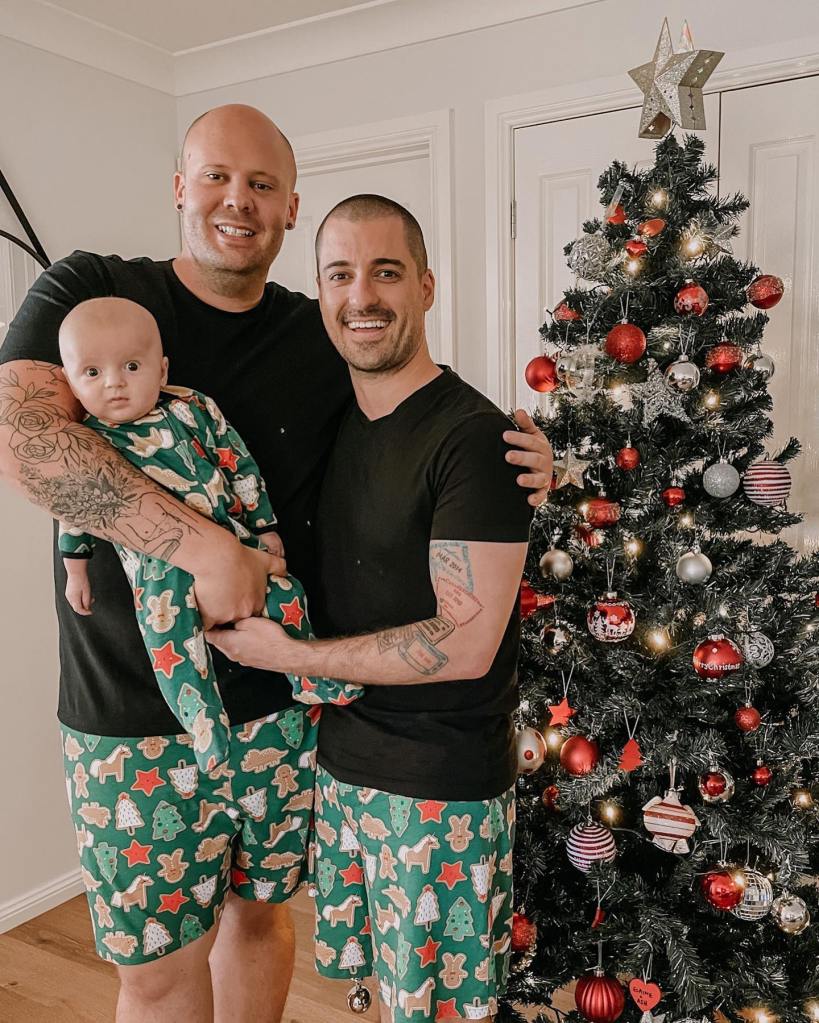
Just sharing a few snippets of that message…
“….how frequent my crashes are. How often I’ve wanted to crawl into a hole and stay there. The tears. The not thinking straight or ability to sequence tasks….. I understand why you might read this message and say F*** it. And delete me. I’d like to delete myself from life too quite often recently….So many times have I been in tears, contemplating calling LifeLine, running through the list of people I could reach out to for help but not wanting to be a burden to anyone, contemplating wanting to go to sleep and not wake up, wishing I’d never done surrogacy for this mental turmoil I’ve been in for 3 months. Feeling like it’s not worth it……this has been my reality for these last few months. I’ve hated it and hate myself and hate the grumpy mother I’ve become…..I feel like a shell of a human being most days and it’s dragging me down and down.”
They are some snippets from that message to Matt and Brendan on Boxing Day. It would have been a horrible message for the Dads to receive at Christmas. Why do I share this? I guess for my own reminder of how messy my brain was and to see how far I’ve come within a few months and with the help of medication and regular counselling. To shine some light into the dark corners of those memories, and to stop running from the shadows.
And only just now, as I write this, while googling the background to that concept of light in the darkness, am I reminded of the meaning of Christmas. A time of rebirth and to welcome the light into our world again. I’m struck that my turning point happened at Christmas and am thankful to those who brought light to me at that time. Thank you Matt, Brendan, Glen, Merindah, Warwick and Zoe.
I’m going to use this opportunity to also thank those people.
One of the many keepsake messages from Merindah.
“That’s surrogacy to me! Riding the wave. The gnarly wave. And we need to do what we can to reach the shore and make it safely back home. I am out paddling in the ocean with you Anna and I’ll help any way I can to see you get back home 💫 “
Warwick Scott. He’s a gay dad-to-be in Sydney and he and his husband Jason have become friends over the years from the surrogacy community. Warwick has checked in on me regularly and he did so again on Boxing Day before I sent the message to the Dads. He helped to delay my sending of it and helped me to see it from a different angle. Having friends in surrogacy is so important, because we need both surrogates and IPs as friends to help us navigate through. I encourage surrogates to make friends with other IPs, and IPs to make friends with other surrogates. You need these friendships built up over time so you can lean on them in times of need.
Warwick would regularly send me messages, sometimes to share photos of cooking, and to remind me that I am awesome.
To which I asked one day while feeling flat
“But whyyyyy am I awesome?”
His reply
“You are just Anna McKie.
An awesome person! With an amazing heart
That’s my opinion and I’m sticking to it!!!”
And from Zoe
“Oh Anna. I know exactly what that burnt out, tired and at capacity feeling is like. Sending you a huge hug. You probably don’t want to hear this, but they’re probably at capacity too. This part of the journey is so hard to navigate and I don’t know any team that has done it seamlessly…It takes huge energy to get through each day and week at this stage for all involved…..You can’t build relationships when your brain is in chaos. You also can’t hear their side when your brain is in chaos.”
Altruistic surrogacy is one heck of a rollercoaster. Although I guess all versions of surrogacy (altruistic and commercial) have relationships at their heart, the payment for surrogates in Australia is not money, rather it’s time and love. Since it’s the only version of surrogacy available to us in Australia, Intended Parents and surrogates often don’t consciously choose this model. There is a level of responsibility each party has to the other in terms of relationships, for the interests of the child born from it, and it is challenging. Matt and Brendan have navigated these murky waters with me and I am deeply grateful to them that they didn’t walk away from me. I’m sure they were sick of me at times, heck, I was sick of myself many times.
Now is an opportune moment to mention some resources of Katrina Hale’s. I strongly recommend surrogacy teams who are planning or pregnant to discuss these suggestions.
The document is called “Surrogate Post Birth Emotional Needs – a Guide for Intended Parents”
She also discusses birth and the fourth trimester in podcasts with Sarah Jefford.
So starting to tie things up. Dr Anna touched base with me in early January and I wrote the following to her:
“Well….things probably got worse before they got better. Around Christmas I hit some pretty dark patches. Now I’m feeling a bit better, I can see that I really wasn’t in a good spot. Oh if only hormones and chemical imbalances could be seen and measured!
I went back to my GP between Christmas and New Year and increased the antidepressant dose up one notch. The blood test results also showed slightly below the range for thyroid levels so we have started on meds for that. Katrina Hale also kindly saw me over the Christmas break and when she suggested another session the following week, and I asked if that was too soon, she said “you’re not in a good place Anna, I’ll see you next week”. I’ve now got a mental health care plan and get the rebates so less for the dads to pay for those sessions. I’m engaging with my employee assistance program again and starting up counselling with the lady I chatted to last year. So lots of supports in place. Still a bit moody and up and down, but hopefully moving forward.
I think part of the reason I hesitated to consider what I had as postnatal depression was because of the word “depression”. I didn’t necessarily feel depressed. I felt muddled, not able to sequence tasks like I normally could, slightly sad, slightly anxious but I didn’t click with the word depressed. Made me wonder if other women have ever felt the same and made me think PND might be better worded as postnatal
unsettled
Or
Confusion
Or
‘Out of sorts’
Or
struggling
For me, if I ever chat to women in the future who are postnatal, I might share this analogy of mine as it describes what I was experiencing better I think, but then it still helps me to accept that the medication that helps me to be less muddled falls under the category of PND (or ssri etc)”
Dr Anna’s reply – and again I share this, with her permission, to get the insights from a GP who has also been a surrogate.
“The word “depression” is a societally loaded label indeed. It makes people feel very uncomfortable.. But it is just a word, a label. Depression can present in SOO many different ways, and with such a broad variety of symptoms. The bottom line of this diagnosis is that your brain isn’t working properly – so that can manifest in such a wide variety of ways. Certainly feeling muddled, uncertain, indecisive, ruminative, with impaired concentration … these presentations are very very common in my experience. Irritability and lowered thresholds for general distress are SUPER common, without someone necessarily feeling “sad” or “depressed”, or having suicidal / self-harm thoughts. The bottom line is: the drugs work. For the vast majority of people….Never forget that (sex/pituitary) hormones affect Every Single Cell in your body, including your brain. Estrogen soars in pregnancy, and drops rapidly afterwards. Prolactin can also be a feel good hormone… you stop BF / expressing, and some people will absolutely crash. SSRIs/SNRIs totally put a chock in that spinning / spiralling wheel, and give your brain space to stabilise, to reset. You will get there.”
I hope reading that helps at least one other person to know that it’s not your fault if your brain is struggling, if your brain isn’t coping.
If you had a broken arm, you would seek help.
If you’re feeling muddled, seek help.
Or at least start a conversation to put it on peoples’ radar.
We can’t underestimate the impact, from a mother nature point of view, of birthing a baby and then not raising that baby. Our brains know that the baby is with its parents, and we are glad that it is. That’s what we signed up for in surrogacy and it brings us joy to know we helped our friends become parents. But this is what Katrina talks about when she calls it “Head, Heart, Hormones”. Our head and our heart know that the baby is safe and loved, but our body is missing a baby. Our body probably thinks the baby has died. Our bodies are grieving a lost baby. Our bodies aren’t joyful. They are navigating a postpartum period in opposition to our brain. The postpartum period for our body is confusing – sometimes happy if we express milk, but trying to adjust to not having daily cuddles with the baby it grew and birthed.
So there you have it. This is my story.
My name is Anna McKie and I am surviving postnatal depression after the birth of my surrogate baby.
It sucked.
I got help.
And now 7 months later, I can say I’m doing ok.
Thank you for coming on this safari with me.
Sharing my email address in case anyone needs to reach out for support – anna@surrogacyaustralia.org

 Surrogacy Safari